Work Hours
Monday to Friday: 10.00 - 19.00




A cloud placement decision rarely fails in a way anyone notices. Unowned infrastructure behaves the same way: it keeps working until the cost, the risk, or the uncertainty becomes too visible to ignore.
The systems work. The pipelines run. The cloud account processes workloads without incident. And yet the bill is higher than it should be, the security posture has gaps nobody planned for, and a quiet sense of uncertainty has settled over the engineering team.
Not because the technology is broken. Because nobody clearly owns the review.
This is not a problem that announces itself. It arrives gradually as the company grows: more services, more teams, more infrastructure, and less of the clear accountability that existed when everything was smaller. What starts as one or two engineers knowing every system they built becomes, over time, a collection of services that run reliably but are not actively understood by anyone.
Teams should ask that question regularly: does this still make sense for where we are now? Fewer people end up asking it. Not because nobody cares, but because it is no longer clear whose job it is.
That distinction sits underneath a wider pattern. Flexera’s 2026 State of the Cloud report found that wasted cloud spend rose to 29% this year, the first increase after five straight years of decline. Cloud-based AI workloads are part of that shift, bringing new and less predictable consumption patterns that older review habits do not always account for. The FinOps Foundation’s 2026 survey points in the same direction from a governance angle: 98% of respondents now manage AI spend, up from 31% two years earlier. That is an ownership gap as much as a technical one, and closing it is what FinOps governance is actually for.
What Unowned Infrastructure Actually Costs
The most visible cost of unowned cloud resources is the bill. It is rarely the only one.

Cloud cost drift
Cloud cost drift happens when infrastructure holds the shape of decisions made in different conditions. An instance type selected for a workload profile that has since changed. A multi-region setup added for a single enterprise deal that is no longer active. Reserved capacity purchased during a growth phase that has since plateaued.
Right-sizing tools can identify inefficiencies at the resource level. What they cannot do is evaluate whether the architecture still fits the business. That requires human judgement, applied to current conditions, by someone with enough context to make the call.
When ownership is absent, that judgement does not happen on a schedule. It happens reactively, when the gap between actual spend and expected spend becomes too large to ignore. This is where cloud cost management stops being a spreadsheet exercise and becomes an ownership question. For more mature teams, this is often where traditional right-sizing starts to plateau. The obvious waste gets removed first. What remains usually needs context: why the workload exists, who depends on it, and whether the original architecture still makes sense.
Security exposure
Security exposure accumulates in a similar way. Not through single dramatic failures, but through small decisions that were never revisited. A secret committed in a hurry and never rotated. An access policy extended for a contractor whose engagement ended. A third-party integration granted broader permissions than necessary because the configuration was done under time pressure.
The scale of this is larger than most teams assume. GitGuardian’s State of Secrets Sprawl 2026 report recorded nearly 29 million new hardcoded secrets pushed to public GitHub repositories in 2025 alone, a 34% year-on-year increase.
More telling for the ownership argument: 64% of secrets that were valid in 2022 are still not revoked in 2026. Not because nobody found them. Because finding a leaked credential and someone being accountable for closing it out are two different things, and most teams only have the first one covered.
Each of these decisions made sense in context. The problem is that nobody with a mandate to review them ever took them on. They sit in version history, in IAM configurations, in tool settings, quietly expanding the attack surface of a system that, by every operational metric, appears healthy.
Operational uncertainty
Operational uncertainty is harder to quantify but equally real. When infrastructure ownership is unclear, engineering teams carry a background weight that does not show up in any dashboard. Questions about who is responsible for something, whether a configuration is intentional or accidental, whether a cost spike reflects a feature or a failure, all of these take time to resolve, generate friction, and slow down the teams trying to build on top of the infrastructure.
A team sees a cost increase, but nobody knows whether it came from a planned release, a forgotten test environment, or a service that quietly scaled beyond its original assumptions. Resolving that takes a meeting, sometimes several. None of that shows up as a line item, but all of it is a cost.
The Difference Between Working and Owned
A system can be working and unowned at the same time. Cloud infrastructure ownership is not the same thing as operational uptime, and that gap is the core of the problem. It is worth being precise about what the distinction means.
A working system processes its inputs, produces its outputs, and stays within acceptable operational bounds. Uptime is high. Error rates are low. Alerts are quiet.
An owned system has all of that, plus active accountability. There is a person or team reviewing cost trends against business activity, understanding why past decisions were made, and checking whether the conditions behind those decisions still exist. When the system drifts out of alignment with what the business needs, they have a clear mandate to change it.
Most infrastructure review conversations focus on tooling: dashboards, tagging schemas, anomaly detection. These are useful inputs to a review process. They are not a review process on their own.
The mechanism that actually catches problems before they become expensive is not a tool. It is a person with a clear job to do, checking in on a set rhythm, who knows enough about the system to make the call.
That person needs to exist. In many growing companies, they do not.
Why Ownership Erodes
Infrastructure accountability rarely disappears through neglect. It is worth understanding how infrastructure ends up unowned, and in most cases the cause is growth.
At the earliest stage, ownership is obvious because the infrastructure and the team are both small. The person who built something is still there, still using it, still accountable for it in the most practical sense.
As the company grows, this changes. The company adds new services. Teams form. People change roles or leave. A team building a different version of the product inherits infrastructure built for the old one. Knowledge concentrates in individuals who may not stay, and disperses when they go.
This is not usually a failure of care. It is what happens when a team grows faster than its ownership habits. The question is whether the organisation keeps ownership visible as it grows, or leaves it to emerge informally.
Many companies leave ownership to emerge informally. For a while, that works. Then the team grows, the infrastructure spreads, and the gaps become harder to close after the fact.
What a Useful Ownership Model Looks Like
The answer is not a large governance framework. For most growing companies, the answer is closer to clear assignment, minimal overhead, and regular rhythm.
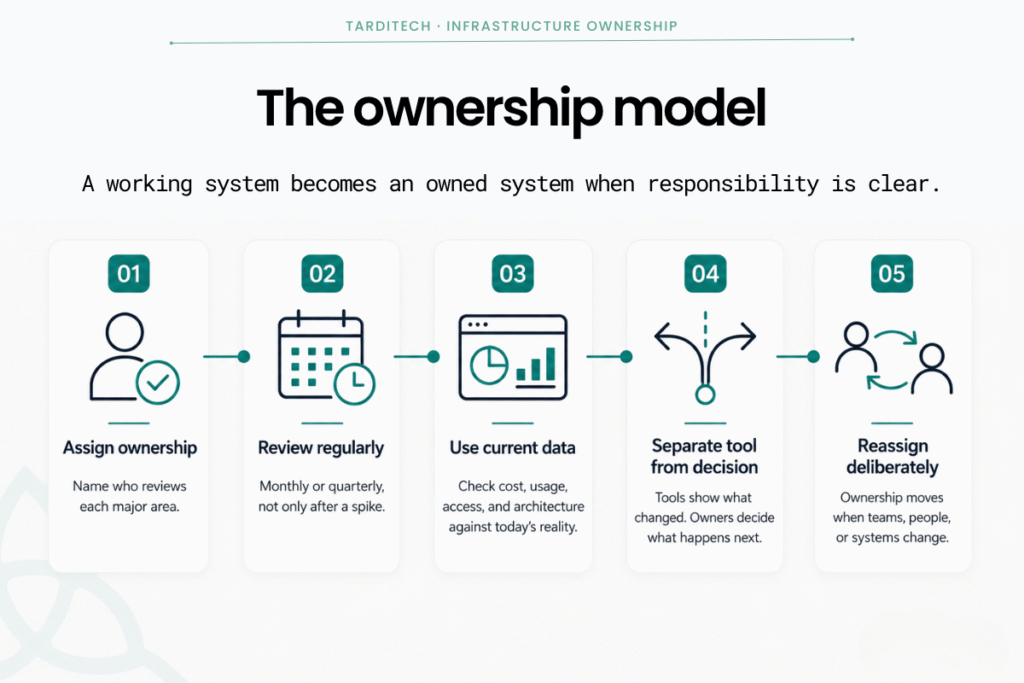
- Assign ownership explicitly. For every meaningful area of infrastructure, name a person or team with a clear mandate to review it. Not just to operate it, but to assess whether it still makes sense.
- Keep the review lightweight. A brief monthly or quarterly session covering cost trends, security state, and whether the architecture still fits the workload. This does not need to be a large undertaking. It needs to be a consistent one.
- Put it on a schedule, not a trigger. Reactive review only catches problems large enough to notice. A regular cadence catches drift while it is still cheap to correct.
- Separate the tool from the decision. Cost and security tooling should feed the review, not replace it. The tool reports what is there. The owner decides what to do about it.
- Revisit the assignment as the team changes. Ownership that was clear six months ago may not be clear now. When someone changes roles or leaves, the review mandate needs to move with intention, not by default.
The specific mechanism matters less than its existence. Some teams run this through an internal platform engineering function. Others bring in external expertise for periodic reviews. What matters is that the question of whether infrastructure still makes sense gets asked regularly, by someone with the context and mandate to act on the answer.
Download the Cloud Infrastructure Ownership Checklist
Before the tooling conversation starts, it helps to answer a simpler question first: who owns the review?
Use this checklist to identify where ownership is clear, where it has drifted, and which decisions need a fresh look.
Where tooling fits
This is not an argument against tools. Cost visibility and security scanning are both genuinely useful, and they are the fastest way to see what a review actually needs to look at.
UmbraFin surfaces cost and usage drift after deployment, so a reviewer is working from current numbers rather than the assumptions behind the original decision. SecretScan, which is free to use, checks repositories and commit history for what may have been committed and forgotten. It turns “we think this is clean” into something a reviewer can actually confirm.
Neither tool decides anything. They shorten the distance between “something might be wrong here” and a reviewer having enough information to make the call. If the owner does not exist, even the best tool is a dashboard nobody acts on.
Cloud Infrastructure Ownership Is the Fix
Infrastructure that nobody clearly owns does not fail catastrophically. It drifts.
Costs increase without a single identifiable cause. Security exposure grows in the spaces between reviews. Architectural decisions that were correct once become quietly incorrect as the business changes shape around them. We covered the mechanics of that drift from the placement side in our piece on re-evaluating cloud workload placement. Ownership is the reason those reviews happen at all.
The fix is not complex. It is clarity about who is accountable, a lightweight review process, and the discipline to maintain both as the organisation grows.
Most of the cloud cost and security problems that surface at growing companies are not purely technology problems. They are ownership problems. Ownership problems do not get solved by adding another tool to the stack.
TardiTech works with engineering teams on exactly this gap, through FinOps consulting for the cost side and platform engineering support for the operational side. If the review process behind your infrastructure decisions is no longer clear, we can help you make it visible again.