Work Hours
Monday to Friday: 10.00 - 19.00



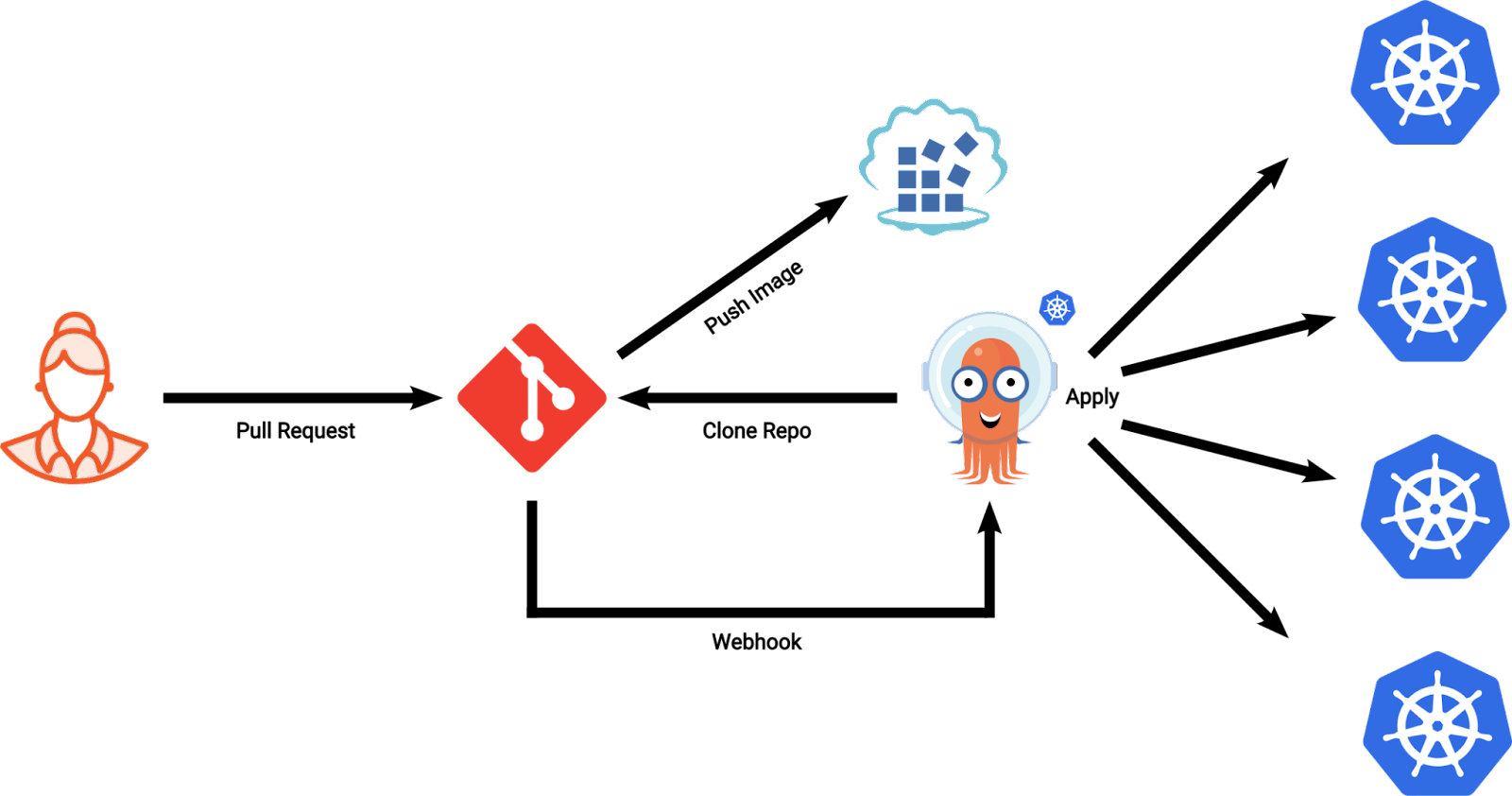

Kubernetes and ArgoCD are essential tools in modern DevOps, enabling seamless, automated application deployment. By combining container orchestration with GitOps principles, organizations can achieve faster, more reliable deployments while maintaining full visibility and control.
In this guide, we’ll explore how ArgoCD works with Kubernetes, highlight key benefits, and share best practices for implementing GitOps continuous deployment in your environment.
Kubernetes: The DevOps Cornerstone
Before diving into ArgoCD, let’s recap what Kubernetes (K8s) is all about. Specifically, Kubernetes is an open-source system designed to automate deploying, scaling, and managing containerised applications.
Why Kubernetes matters
This system enables DevOps teams to quickly deploy their applications in containers across multiple hosts. Consequently, it becomes easier to manage and scale applications without manual intervention. Furthermore, Kubernetes has become the industry standard for container orchestration, making it essential knowledge for modern DevOps professionals.
Introduction to ArgoCD: GitOps in Action
What is ArgoCD?
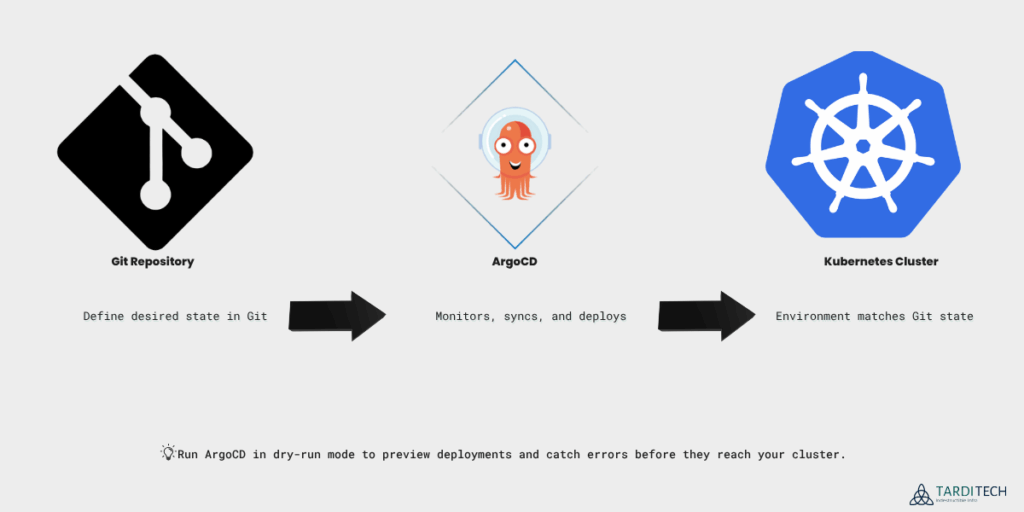
ArgoCD is a declarative, GitOps continuous deployment tool for Kubernetes. It treats Git repositories as the single source of truth for application definitions and configurations, ensuring that your live environment always matches the desired state stored in Git.
How ArgoCD works
ArgoCD operates on a simple but powerful premise: your Git repository becomes the single source of truth. Therefore, any changes you want to deploy are made in Git, not directly in your cluster. This approach provides inherent version control and audit trails for all deployments.
Key differences from traditional CI/CD
Unlike traditional continuous integration tools, ArgoCD focuses on continuous deployment by constantly synchronising your live environment with your desired state. Moreover, this eliminates configuration drift – a common problem where environments gradually diverge from their intended state.
ArgoCD and Kubernetes: A Powerful Duo
Together, ArgoCD and Kubernetes make an excellent team for deploying and managing your applications. Here’s why this combination is transformative:
1. Declarative and version-controlled deployments
With ArgoCD, you define your desired application state in a Git repository. This ensures version control and helps maintain a single source of truth. Additionally, if something goes wrong, you can always rollback to a previous state with a simple Git revert.
Benefits:
- Complete audit trail of all changes
- Easy collaboration through Git workflows
- Simple rollback mechanisms
- Compliance and governance built-in
2. Continuous deployment with automatic synchronisation
Changes made in the Git repository trigger a deployment process in the Kubernetes environment. Consequently, your application state is always in sync with your Git repository. Furthermore, this reduces manual deployments and human error.
Real-world impact:
- Faster time-to-production
- Reduced deployment failures
- Consistent environments across teams
3. Simplified cluster management
ArgoCD continually monitors your running applications and compares the live state against the desired state defined in Git. Therefore, if it detects any deviations, it alerts you and can optionally take corrective action.
This continuous monitoring means you always know exactly what’s running in your cluster and whether it matches your intentions.
4. Self-healing capabilities
If self-healing is enabled, ArgoCD can automatically correct any deviations from the desired state. This can be very useful for addressing issues that may arise in your deployments. For instance, if someone accidentally deletes a pod, ArgoCD will recreate it to match the desired state.
5. Multi-environment deployment management
ArgoCD can manage deployments across multiple environments (like dev, staging, and production) right from the same Git repository. This makes it an excellent tool for managing multi-cloud and hybrid cloud deployments across various stages of your development lifecycle.
Use cases:
- Development environment automation
- Staging validation workflows
- Production deployment orchestration
- Disaster recovery environments
Best Practices for ArgoCD and Kubernetes Implementation
Getting started with ArgoCD
When implementing ArgoCD and Kubernetes together, consider these best practices:
1. Organise your Git repositories: Structure your Git repos clearly with separate directories or branches for different environments. Additionally, use meaningful naming conventions for applications and configurations.
2. Implement RBAC controls: Ensure proper role-based access control (RBAC) is configured in your Kubernetes clusters. Consequently, this restricts who can make changes and enhances security.
3. Use ArgoCD notifications: Enable notifications to alert your team of deployment status changes. Furthermore, this improves visibility and enables faster response to issues.
4. Set up automated testing: Before ArgoCD deploys changes, ensure your CI pipeline validates them. Therefore, problematic code is caught before reaching production.
5. Monitor your deployments: Use tools like Prometheus and other CNCF monitoring projects to track the health of your applications post-deployment.
Common Challenges and Solutions
Configuration drift
Challenge:
Even with version control, drift can occur if manual changes are made directly to clusters.
Solution:
Enable ArgoCD’s auto-sync feature and use admission controllers to prevent direct cluster modifications.
Multi-cluster management
Challenge:
Managing deployments across multiple Kubernetes clusters adds complexity.
Solution:
ArgoCD supports managing multiple clusters from a single control plane, simplifying multi-environment deployments.
Secrets management
Challenge:
Storing sensitive data in Git repositories poses security risks.
Solution:
Use external secret management tools like HashiCorp Vault or AWS Secrets Manager integrated with ArgoCD.
Real-World Applications of ArgoCD and Kubernetes
Organisations across industries leverage ArgoCD and Kubernetes for continuous deployment:
- SaaS Companies: Deploying updates multiple times per day across environments
- Financial Services: Managing compliant, auditable deployments with version control
- E-Commerce: Scaling applications automatically during traffic spikes
- Technology Startups: Rapid iteration and deployment without manual overhead
The Future of Continuous Deployment
As DevOps practices continue to evolve, GitOps enabled by tools like ArgoCD is becoming the standard approach for continuous deployment. Moreover, this declarative, Git-centric approach aligns perfectly with infrastructure-as-code principles and modern cloud-native architectures.
Final thoughts
In a world where speed and efficiency are paramount, tools like ArgoCD and Kubernetes come in very handy. ArgoCD helps ensure that your Kubernetes environments match your desired state as defined in your Git repositories. It’s a tool that encourages best practices in continuous integration and continuous deployment (CI/CD) and takes considerable stress out of managing deployments.
Moreover, the combination of ArgoCD and Kubernetes provides:
- Reliability: Automated, repeatable deployments
- Auditability: Complete version control and change history
- Speed: Rapid deployment cycles with reduced manual intervention
- Control: Always knowing what’s running and why
By mastering ArgoCD and Kubernetes, you position your organisation for modern, efficient, and scalable application delivery.