Work Hours
Monday to Friday: 10.00 - 19.00




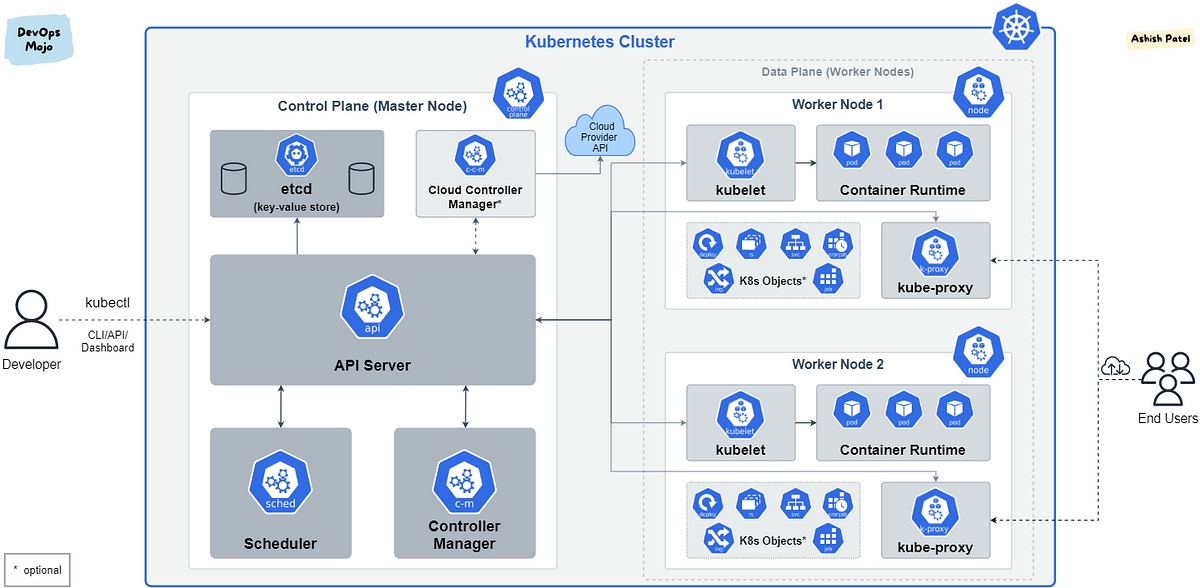

If you’re building or scaling applications, you’ve probably heard of Kubernetes, but what makes it such a game-changer for modern software deployment? In this guide, we’ll break down Kubernetes container orchestration, explore its key features, and explain why it’s become essential for businesses managing containerised applications at scale.
Understanding Kubernetes is crucial for modern cloud infrastructure. Whether you’re running microservices, optimizing DevOps workflows, or scaling applications efficiently, Kubernetes ensures your containerized workloads run smoothly across multiple hosts.
What is Kubernetes Container Orchestration?
Understanding the basics
Kubernetes (aka K8s) is an open-source platform originally developed by Google. It allows teams to deploy, manage, and scale containerised applications automatically, across multiple servers, with minimal manual intervention.
Think of Kubernetes as a conductor for your containerized applications: it keeps everything in sync, ensures high availability, and automates complex processes so your team can focus on building features instead of managing infrastructure.
Manual vs. automated container management
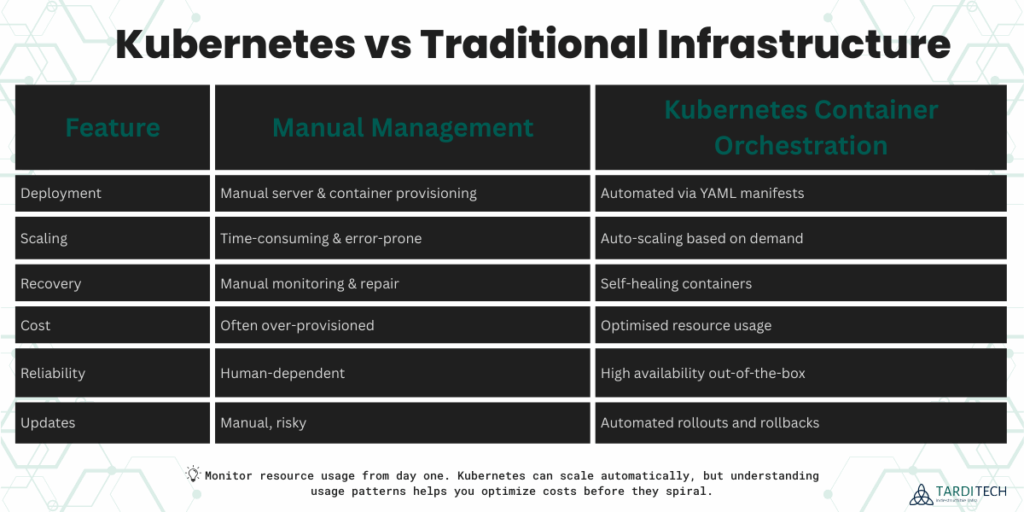
Without orchestration, managing containers quickly becomes overwhelming. Imagine scaling an app to hundreds of containers manually: monitoring, networking, and resource allocation would be a nightmare. Kubernetes automates all of this, allowing your teams to focus on product development instead of infrastructure headaches.
Why Kubernetes Container Orchestration Matters
The container revolution
Containers have transformed application deployment by providing consistent environments across development, testing, and production. They’re lightweight, efficient, and eliminate many virtual machine overheads.
But containers introduce new challenges:
-
How do you monitor hundreds of containers?
-
How do you handle failures automatically?
-
How do you scale efficiently without overspending?
Kubernetes solves these problems elegantly.
Pro Tip: 💡 Kubernetes is particularly useful for startups and fast-growing teams because it lets you scale dynamically—so you pay only for what you use.
The problem Kubernetes solves
Imagine this scenario: your application runs on 50 containers across multiple servers, and one fails at 2 AM. How do you:
-
Detect the failure?
-
Redirect traffic to healthy containers?
-
Replace the failed container automatically?
With Kubernetes, all of this happens automatically. It monitors, repairs, scales, and manages your infrastructure, eliminating manual intervention and ensuring your applications remain highly available.
Key Features of Kubernetes Container Orchestration
1. Service discovery and load balancing
Kubernetes can expose containers using DNS names or dedicated IP addresses. When traffic spikes, it automatically distributes network load, ensuring deployments remain stable.
2. Storage orchestration
Kubernetes lets you mount storage systems of your choice, whether local storage, cloud providers like AWS or GCP, or network systems like NFS, iSCSI, or Ceph.
3. Automated rollouts and rollbacks
Describe your desired container state, and Kubernetes ensures the actual state matches. Updates are gradual and reversible.
Real-world example: Upgrading an app from version 1.0 → 2.0. Kubernetes gradually replaces old containers and automatically rolls back if something fails.
Pro Tip: 💡 Use rolling updates for zero-downtime deployments and safer production rollouts.
4. Self-healing capabilities
Kubernetes automatically restarts failing containers, replaces unhealthy ones, and only routes traffic to ready containers.
5. Secret and configuration management
Manage passwords, tokens, SSH keys, and other sensitive info securely without rebuilding container images. This separates configuration from application code a critical security best practice.
6. Resource optimisation and scaling
Kubernetes automatically scales applications based on demand. Extra replicas are added during high traffic and removed when unnecessary, helping optimise cloud costs. Learn more in our cloud cost optimisation strategies.
Real-World Applications of Kubernetes
Enterprise deployments
Banks, SaaS companies, and e-commerce platforms manage thousands of containers across multiple data centres using Kubernetes.
Microservices architectures
Kubernetes handles service discovery, communication, and scaling for microservices automatically. For more, see our guide on ArgoCD and Kubernetes GitOps.
Multi-cloud environments
Kubernetes enables consistent container orchestration across AWS, Azure, GCP, or on-premises environments. Understanding multi-cloud and hybrid cloud strategies helps you make informed decisions.
DevOps and continuous deployment
Teams integrate Kubernetes with CI/CD tools like ArgoCD to maintain desired application states and automate deployments.
Getting Started with Kubernetes
-
Learn the basics: Pods, deployments, services, and namespaces. Start with the official Kubernetes documentation.
-
Set up a local cluster: Experiment using Minikube or Docker Desktop.
-
Deploy apps and practice scaling: Replica scaling, rolling updates, and service discovery translate directly to production.
-
Implement monitoring and observability: Use Prometheus for metrics and Fluentd for logging.
-
Production plan: Apply security best practices, cost monitoring, and disaster recovery before going live.
The Future of Kubernetes
Kubernetes continues to evolve rapidly. The ecosystem grows with new tools and integrations constantly. As organizations increasingly adopt cloud-native architectures, Kubernetes container orchestration has become essential infrastructure knowledge.
Moreover, learning Kubernetes positions you at the forefront of modern software engineering practices.
Final thoughts
Kubernetes container orchestration is more than a trend; it’s a foundational technology for modern software deployment. It solves problems traditional infrastructure cannot handle at scale, improves reliability, reduces operational overhead, and optimises cloud costs.
Whether you’re a developer, systems engineer, or CTO, understanding Kubernetes is a smart investment for career growth and business success.